Editorial posture

The library is organized around decisions that keep recurring in payment architecture, AI systems, and Doric product work. New notes lead by publish date, while topic lanes connect related arguments without turning the index into an archive wall.

Decision frame

Recommendation, rejected paths, and the operating proof behind the call.

Visual proof

Diagrams and original artifacts stay near the argument they explain.

Source posture

Public claims stay tied to released work or cited material.

Architecture

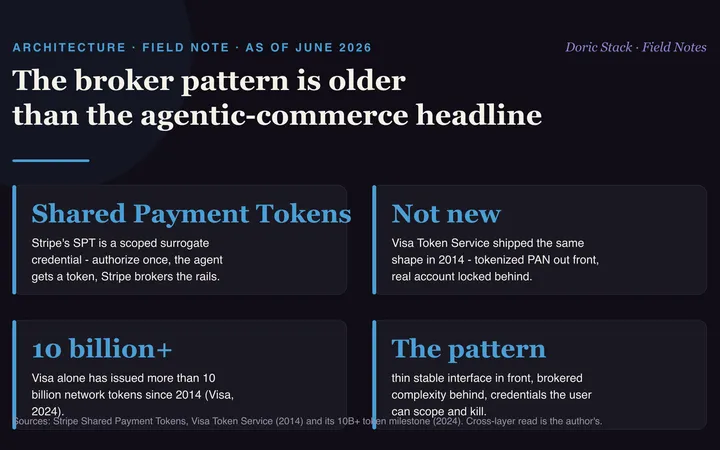
The broker pattern is older than the agentic-commerce headline

Stripe Shared Payment Tokens are the agentic-commerce headline, but anyone who ran a card tokenization rollout in 2014 recognizes the shape in five seconds. A scoped surrogate credential with a thin stable interface in front and brokered complexity behind is not new. Visa Token Service shipped it twelve years ago, and the architects who see the pattern early build the right systems instead of rebuilding every eighteen months.
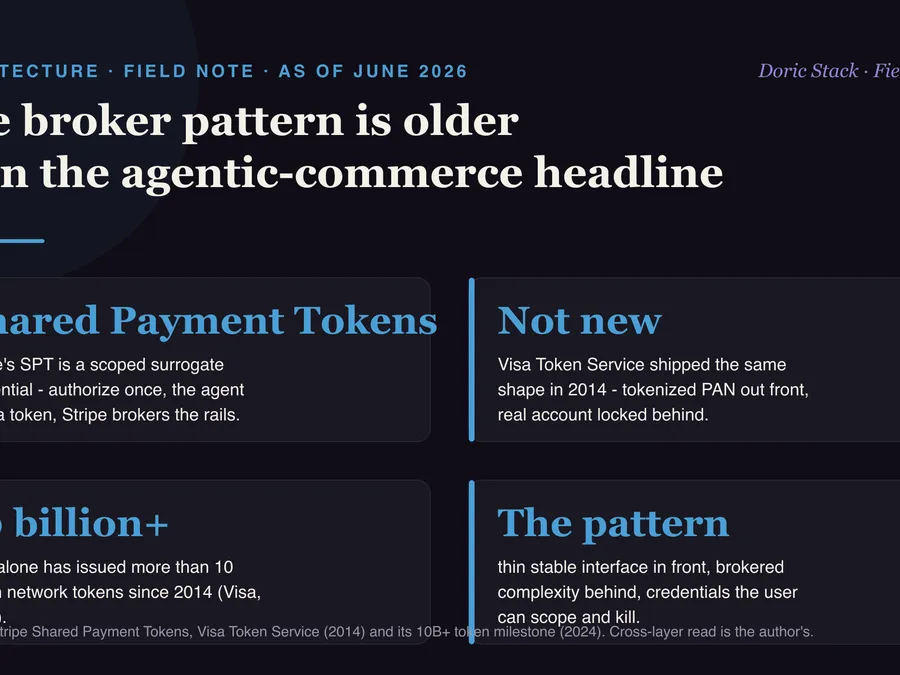
The broker pattern is older than the agentic-commerce headline visual preview

Lead essay

The current Doric argument leads the index ahead of the chronological archive.

Read the note
01 / Payments

Commerce architecture

Merchant-of-record decisions, checkout ownership, billing operations, settlement, reconciliation, and risk boundaries.

02 / AI tooling

Practical AI systems

Agentic commerce, multi-agent orchestration, model fine-tuning, runtime governance, and production deployment.

03 / Build notes

From idea to system

The design, architecture, and operating decisions behind Doric Stack products as they move from prototype to public release.

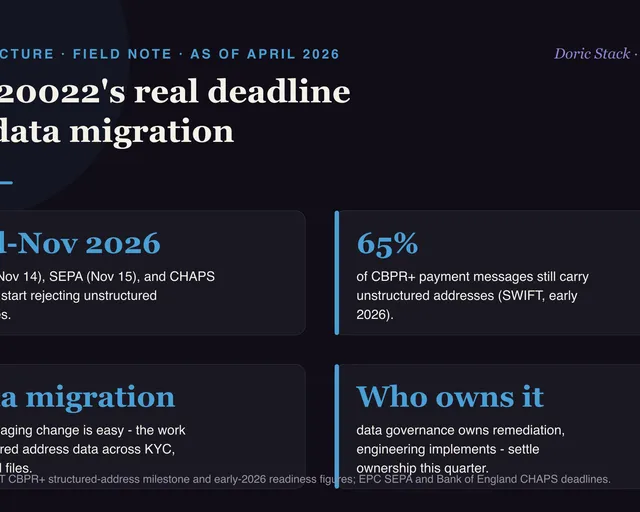
ISO 20022's real deadline is a data migration, not a message change visual preview
By Navin Agrawal Architecture 3 min read

ISO 20022's real deadline is a data migration, not a message change

The translator is ready, the mapping is tested, the structured fields are wired - and the project is still not on track, because the customer records are missing structured address data across KYC, core banking, and correspondent files. In November 2026, SWIFT, SEPA, and CHAPS start rejecting unstructured addresses, and most banks are framing the wrong problem.

Payment platforms have docs. Almost none have a developer experience visual preview
By Navin Agrawal Architecture 2 min read

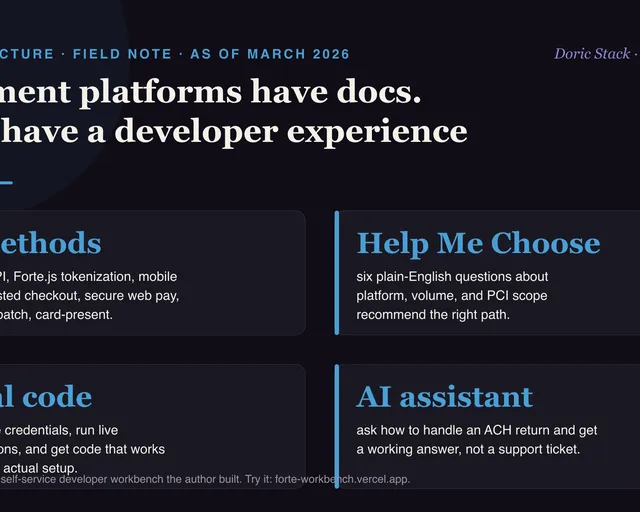
Payment platforms have docs. Almost none have a developer experience

Payment integration usually starts with a PDF, a sandbox that takes days to provision, and a support email that answers in 48 hours - and the third email is where patience dies and a competitor gets Googled. I built a self-service workbench to close the distance between what a platform can do and what a developer can figure out alone.