Field note

The Fed payment account grants the rail, not the safety net

The Federal Reserve proposed a stripped-down payment account for legally eligible institutions. It can clear and settle on Fedwire, FedNow, and National Settlement Service, but it withholds the cushion that made sponsor-bank access survivable: no discount window, no intraday credit, no daylight overdraft, no interest on balances.

Jun 22, 2026 · Navin Agrawal · Payments · 3 min read

The Fed payment account grants the rail, not the safety net

Visual brief

Visual brief

The Fed payment account grants the rail, not the safety net

As of June 2026

For a century, settling your own payments at the Fed meant one thing: a full master account, or a bank in the middle to do it for you. The Fed's payment-account proposal creates a third path, but the design is defined by what it removes.

The account grants access to the rail. It does not grant a bank’s balance sheet. That difference turns liquidity management from a back-office function into the operating model.

Proposal date

May 20

the Federal Reserve asked for comment on a special-purpose payment account in 2026.

Access

Fedwire / FedNow / NSS

eligible institutions could clear and settle through Federal Reserve payment services.

Cushion

None

no discount window, no intraday credit, no interest on balances, and controls to prevent overdrafts.

What the proposal changes

The Federal Reserve’s May 20, 2026 proposal would establish a payment account for legally eligible institutions to use for clearing and settling payments. The proposal does not widen who qualifies for Federal Reserve accounts or services. It changes what a qualifying institution can get: access to payment services without requiring the same full account profile that carries bank-like support.

What the proposal withholds

The limits are the architecture. Payment-account holders would not access the discount window, would not receive intraday credit, would not earn interest on balances at a Reserve Bank, and would use automated controls that prevent overdrafts. Closing balances are capped by expected payment activity, with the board memo describing a maximum closing balance framework up to one billion dollars.
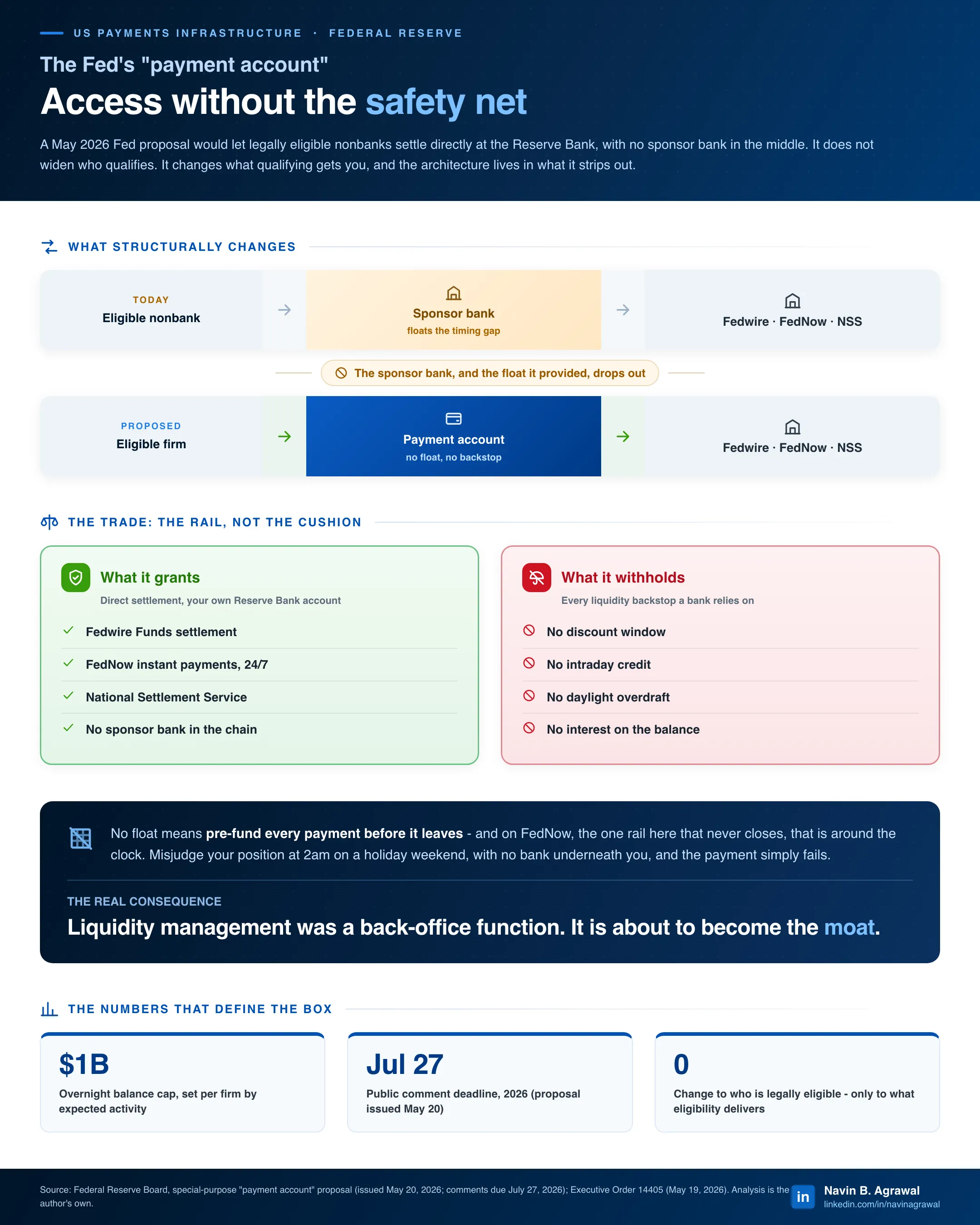
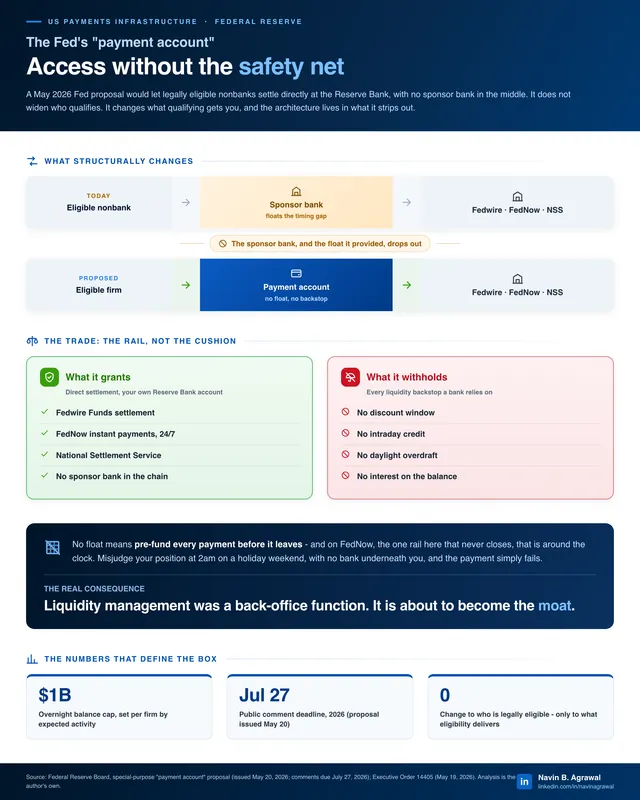
The Fed payment account grants the rail, not the safety net: a May 2026 Federal Reserve proposal would let legally eligible firms settle directly through Fedwire, FedNow, and National Settlement Service, but the sponsor-bank float drops out and the payment account provides no discount window, no intraday credit, no daylight overdraft, and no interest on balances.
Direct access stops being a routing preference when the sponsor bank no longer floats the timing gap.

The sponsor bank was doing more than routing

A sponsor bank did not just pass the payment through. In many operating models it absorbed timing gaps, covered settlement windows, and created a liquidity cushion between outbound and inbound money. Remove that layer and the payment account holder inherits the rail’s operating burden without the cushion that used to sit underneath it.

FedNow makes that burden sharper because it never closes. If a payment can leave at 2 AM on a holiday weekend, the prefunding model has to be alive at 2 AM on a holiday weekend. Misjudge the position and the payment fails. No sponsor bank sits underneath it. The Federal Reserve proposal deliberately withholds that cushion.

Direct Fed access reads like the prize. It is the exam. The firms that pass will be the ones that can hold an intraday cash position on a real-time rail with no bank underneath them.
Was this useful?

Choose once.

Related Posts

View All Posts »
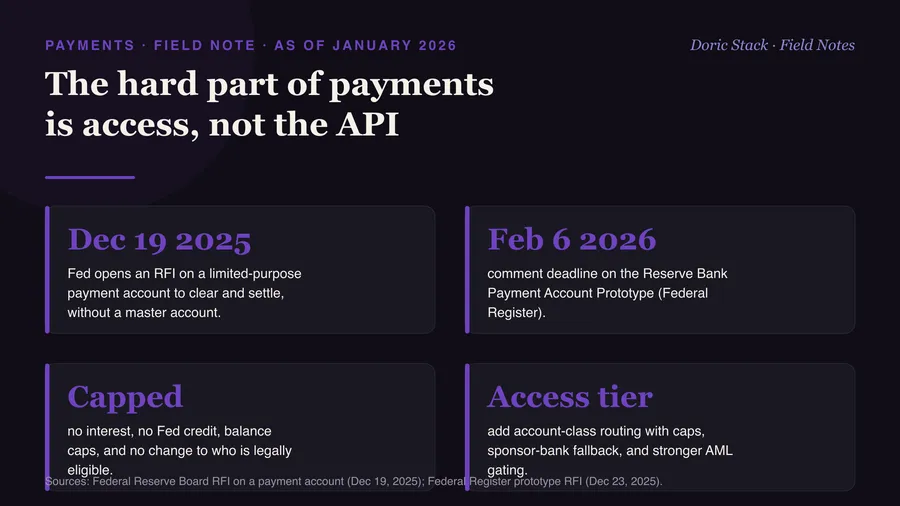
The hard part of payments is access, not the API

The hard part of payments is access, not the API

A payroll rollout taught me the friction is never the integration. It is funding caps, routing permissions, and what can clear directly versus what has to detour through a sponsor bank. That is why the Fed's new payment-account RFI matters - access is becoming a design decision, not just a policy one.

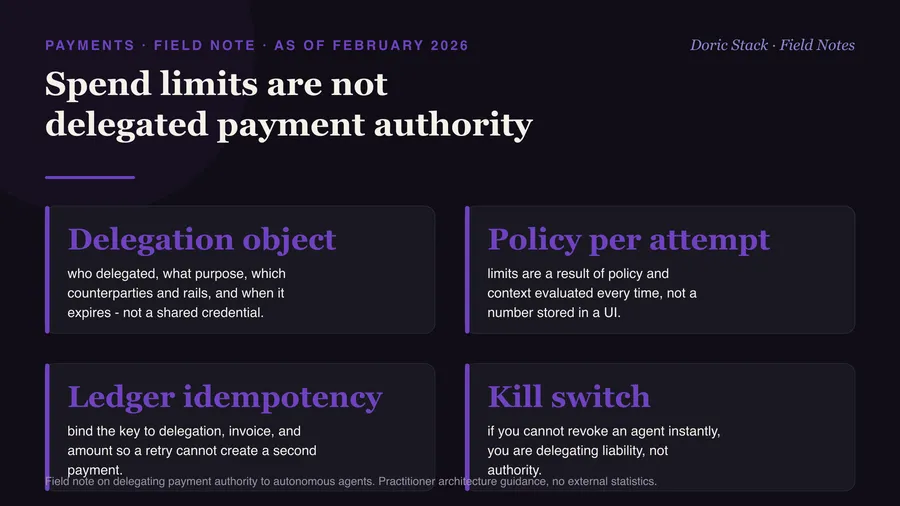
Spend limits are not delegated payment authority

Spend limits are not delegated payment authority

An invoice agent hits a transient timeout, retries, and two payments clear to the same vendor. The model calls it success. Ops calls it a week of cleanup. Spend limits and roles are a speed bump. Real delegated authority is a delegation object, policy on every attempt, ledger-bound idempotency, and an instant kill switch.

ACH's most boring 10 characters just became policy

ACH's most boring 10 characters just became policy

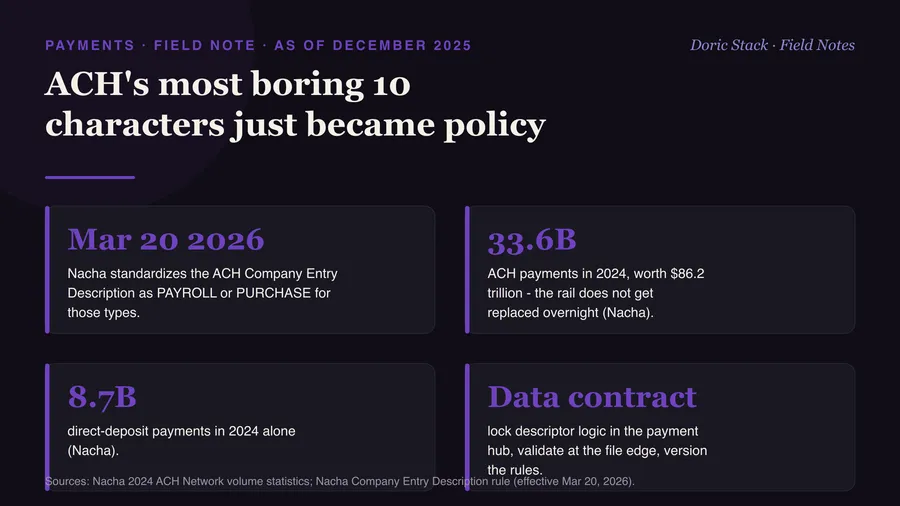
From March 2026, Nacha standardizes the ACH Company Entry Description as PAYROLL or PURCHASE for those payment types. It sounds trivial, but a free-text field becoming a dependable category is what finally lets reconciliation automation stick on a rail that still moves tens of billions of payments a year.

Instant rails now carry wire money. Do the controls?

Instant rails now carry wire money. Do the controls?

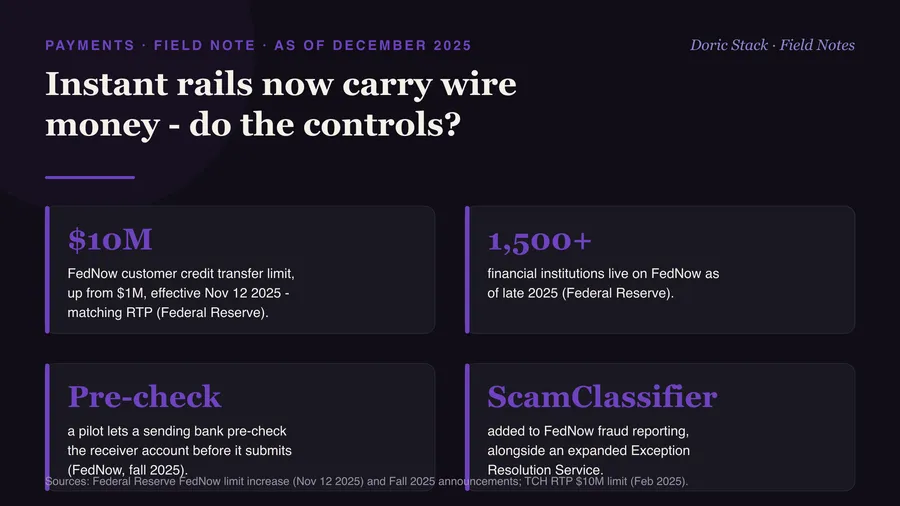
FedNow matched RTP at a $10M network limit in November 2025 and added new risk rails - a receiver-account pre-check pilot, ScamClassifier reporting, an Exception Resolution Service, and 1,500+ banks live. Instant is treasury cash now, and batch-era controls just got a 24/7 bypass.