Editorial posture

The library is organized around decisions that keep recurring in payment architecture, AI systems, and Doric product work. New notes lead by publish date, while topic lanes connect related arguments without turning the index into an archive wall.

Decision frame

Recommendation, rejected paths, and the operating proof behind the call.

Visual proof

Diagrams and original artifacts stay near the argument they explain.

Source posture

Public claims stay tied to released work or cited material.

Payments

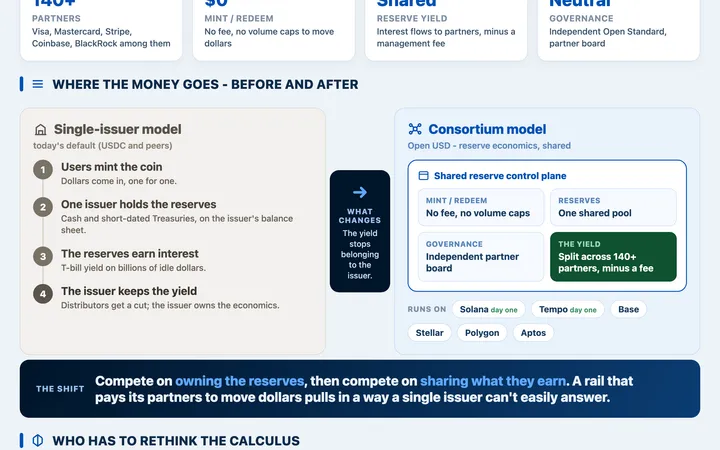
Open USD moves the stablecoin fight from issuing the coin to distributing it

Open Standard announced Open USD on June 30, 2026 with a partner-backed model: no-fee mint and redeem, no volume caps, and reserve economics shared with the businesses moving the money. The technical object is another dollar stablecoin. The strategic move is shifting the revenue fight from holding the reserves to distributing the rail.
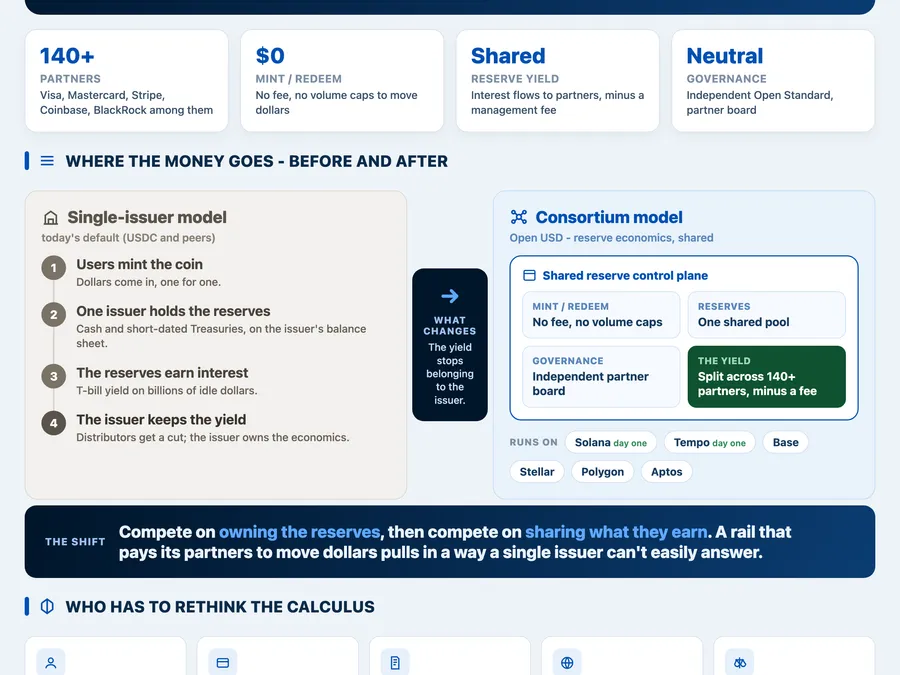
Open USD moves the stablecoin fight from issuing the coin to distributing it visual preview

Lead essay

The current Doric argument leads the index ahead of the chronological archive.

Read the note
01 / Payments

Commerce architecture

Merchant-of-record decisions, checkout ownership, billing operations, settlement, reconciliation, and risk boundaries.

02 / AI tooling

Practical AI systems

Agentic commerce, multi-agent orchestration, model fine-tuning, runtime governance, and production deployment.

03 / Build notes

From idea to system

The design, architecture, and operating decisions behind Doric Stack products as they move from prototype to public release.

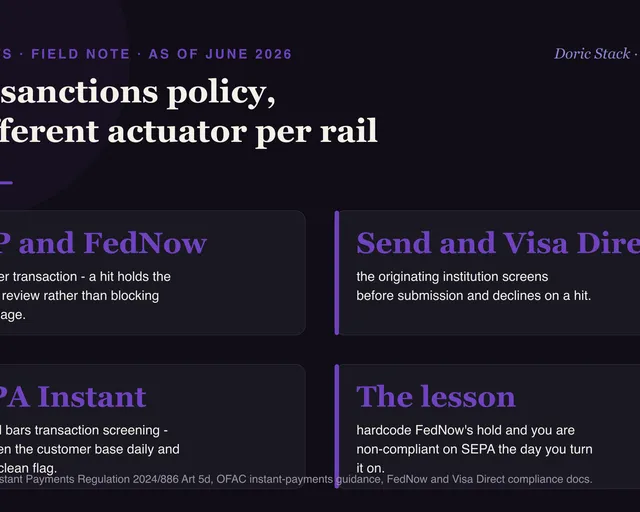
Sanctions screening as code: one policy, a different actuator per rail visual preview
By Navin Agrawal Payments 3 min read

Sanctions screening as code: one policy, a different actuator per rail

The payment is final in under a second and your sanctions analyst is still opening the alert. On an instant rail there is no review window, so the screen has to clear or stop the payment in code, inside the latency budget. The policy model can be common across rails. The action on a hit cannot, because RTP, the card networks, and SEPA Instant each demand a different commit semantic.

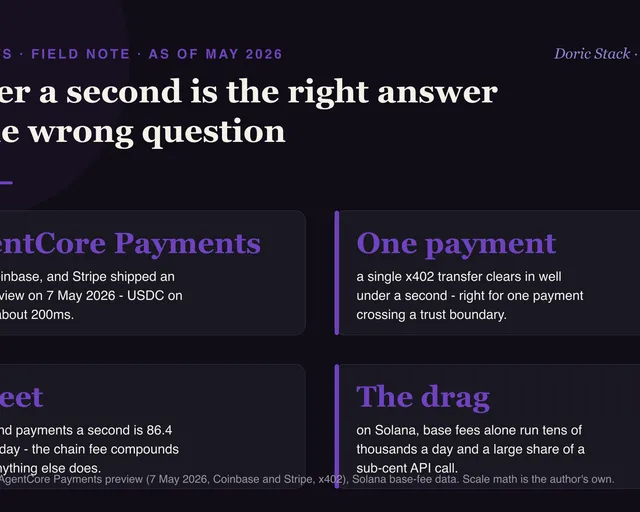
Under a second is the right answer to the wrong question visual preview
By Navin Agrawal Payments 3 min read

Under a second is the right answer to the wrong question

At an AWS Bedrock AgentCore Payments session the question was what happens at a thousand transactions a second, and the answer was settlement in under a second. Both are true and they answer different questions. The right frame for one payment crossing a trust boundary is the wrong frame for a million events a day inside one agent fleet, where the chain fee stacks up before anything else does.