Field note

Open USD moves the stablecoin fight from issuing the coin to distributing it

Open Standard announced Open USD on June 30, 2026 with a partner-backed model: no-fee mint and redeem, no volume caps, and reserve economics shared with the businesses moving the money. The technical object is another dollar stablecoin. The strategic move is shifting the revenue fight from holding the reserves to distributing the rail.

Jul 6, 2026 · Navin Agrawal · Payments · 3 min read

Open USD moves the stablecoin fight from issuing the coin to distributing it

Visual brief

Visual brief

Open USD moves the stablecoin fight from issuing the coin to distributing it

As of July 2026

Every dollar stablecoin runs on the same quiet engine: hold the reserves and earn the interest on them. Open USD attacks that engine by sharing the economics with the businesses that move the money.

The technical object is another dollar stablecoin. The market-structure move is different: stop competing only on who issues the coin, and start competing on who distributes the rail.

Announcement

Jun 30

Open Standard announced Open USD as a stablecoin for global money movement.

Distribution

140+

the launch positioned a broad partner network as part of the product design.

Economics

Shared

mint and redeem with no fee or volume caps, then share reserve earnings after a management fee.

The incumbent model

The single-issuer model is simple. Users mint the coin, one issuer holds the dollars and short-term reserve assets, the reserves earn interest, and the issuer keeps the yield. Distributors may receive a commercial share, but the reserve economics live with the issuer. That is why stablecoin distribution is not only a technical problem. It is a revenue allocation problem.

The Open USD model

Open Standard’s pitch moves the distribution partner to the center of the economics. The launch says Open USD is built for global money movement, with minting and redemption designed around no fees and no volume caps. The reserve economics are intended to flow back to the businesses growing adoption, after Open Standard’s management fee.
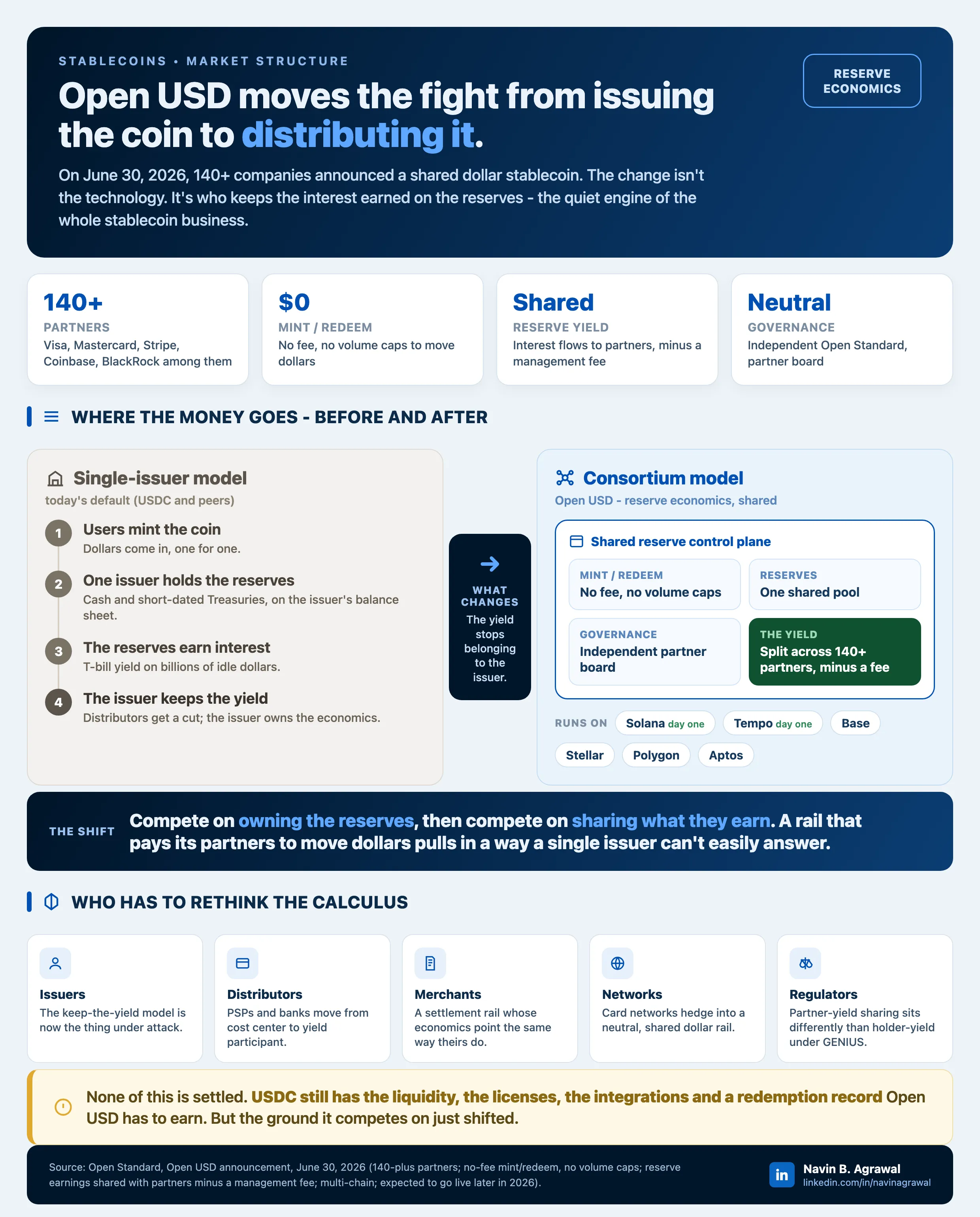
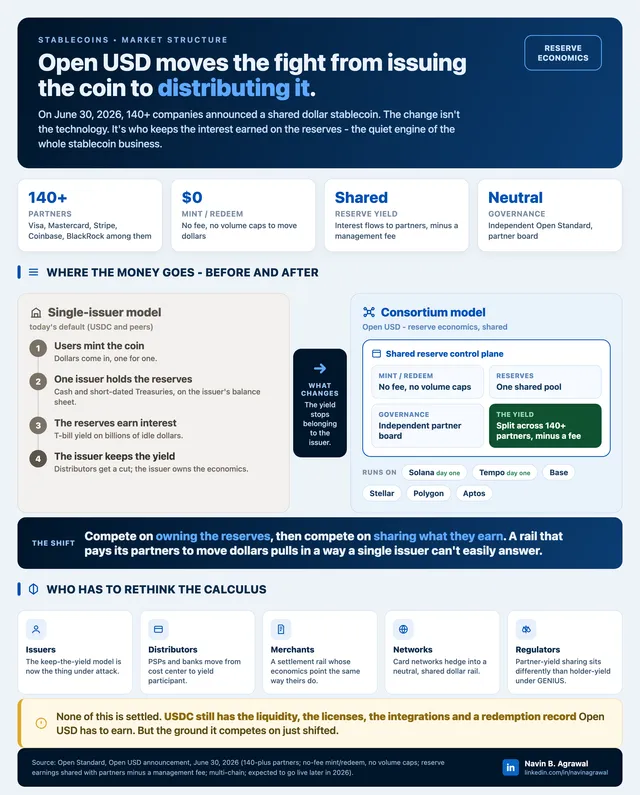
Open USD moves the fight from issuing the coin to distributing it: more than 140 partners, no-fee mint and redeem, no volume caps, shared reserve yield, neutral governance, and a shift from single-issuer reserve economics to consortium distribution economics.
The coin is the visible object. The real product is the reserve-economics distribution model behind it.

Why this matters to payments teams

The operational question changes. A payments platform choosing a stablecoin is no longer choosing only liquidity, redemption history, legal structure, and chain support. It is choosing whether to be a distributor of someone else’s coin or a participant in a shared settlement rail whose economics point back toward the businesses moving volume.

That does not make Open USD the winner. USDC still has liquidity, licensing work, integrations, and a redemption record that any new rail has to earn. The point is narrower and more useful: the axis of competition changed. A rail that pays partners to move dollars pulls differently than a rail where the issuer keeps the reserve yield and pays distributors by separate commercial deal.

The fight shifts from owning the reserves to sharing what they earn. For payment platforms, distribution just became part of stablecoin economics, not a footnote to it.
Was this useful?

Choose once.

Related Posts

View All Posts »
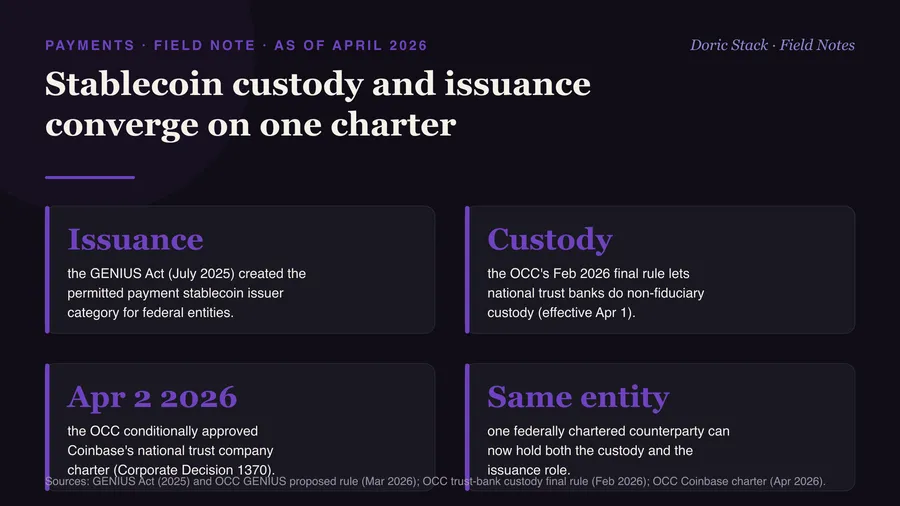
Stablecoin custody and issuance converge on one charter

Stablecoin custody and issuance converge on one charter

Two US regulatory threads just lined up. The GENIUS Act created a federal pathway to issue payment stablecoins, and the OCC's new rule lets national trust banks hold digital assets in non-fiduciary custody - then conditionally chartered Coinbase as one. Issuance and custody can now sit inside the same federally regulated counterparty.

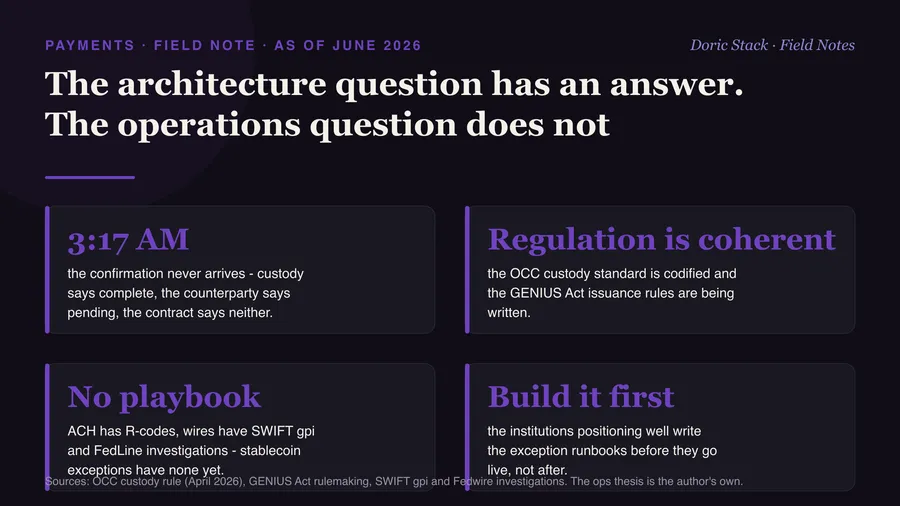
Stablecoin payments have an architecture answer and no operations answer

Stablecoin payments have an architecture answer and no operations answer

At 3:17 AM the confirmation never arrived. Two million in institutional stablecoin, and the custody record said complete, the counterparty said pending, the smart contract said something else again. The regulatory stack is finally coherent. The exception playbook that ACH and wires spent decades building does not exist yet, and that gap is where institutions are walking in.

A chartered bank just put a stablecoin on card settlement

A chartered bank just put a stablecoin on card settlement

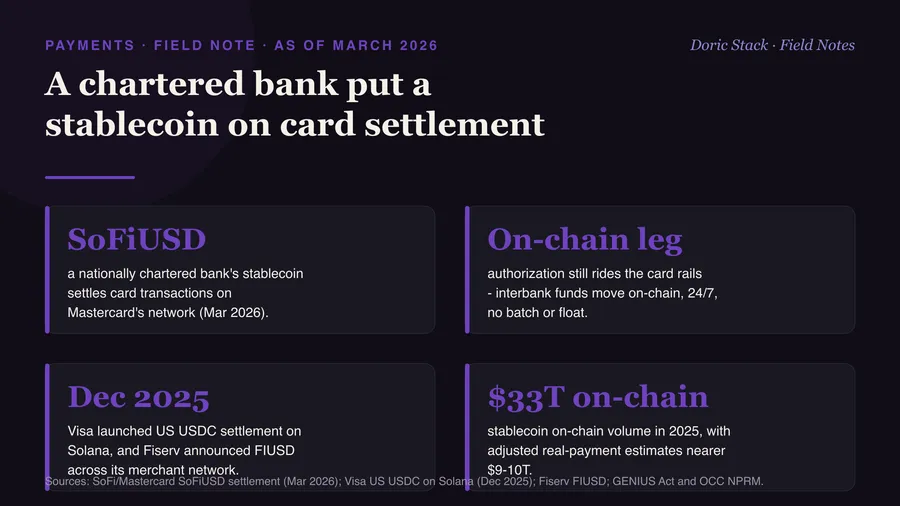
SoFi Bank put SoFiUSD on Mastercard's settlement layer. Authorization still rides the card rails and the merchant sees nothing change, but the interbank fund movement happens on-chain, around the clock, with no batch window and no correspondent float. For the first time, issuers and acquirers get to choose their settlement medium.