Field note

Instant rails: the reality behind the marketing

RTP cleared $246 billion in 2024 and the headlines said instant payments had arrived. The average transaction sizes tell a quieter story - this is high-value institutional money on a faster rail, not the consumer revolution that was promised.

Jun 23, 2025 · Navin Agrawal · Payments · 3 min read

Instant rails: the reality behind the marketing

Visual brief

Visual brief

Instant rails: the reality behind the marketing

As of June 2025

The instant-payments headlines celebrate volume. The average transaction sizes reveal what is actually happening: institutional money found a faster rail, and the consumer revolution is still years out.

RTP processed $246 billion in 2024, up 94% year over year across 343 million transactions. FedNow reached $38.2 billion in its first full calendar year. “Instant payments are taking off,” the headlines said. The usage data tells a quieter, more useful story.

Marketing vs usage (June 2025)

The average-transaction gap, the volume and off-hours figures, the limit split, and the receive-only adoption pattern - the reality behind the adoption headlines.
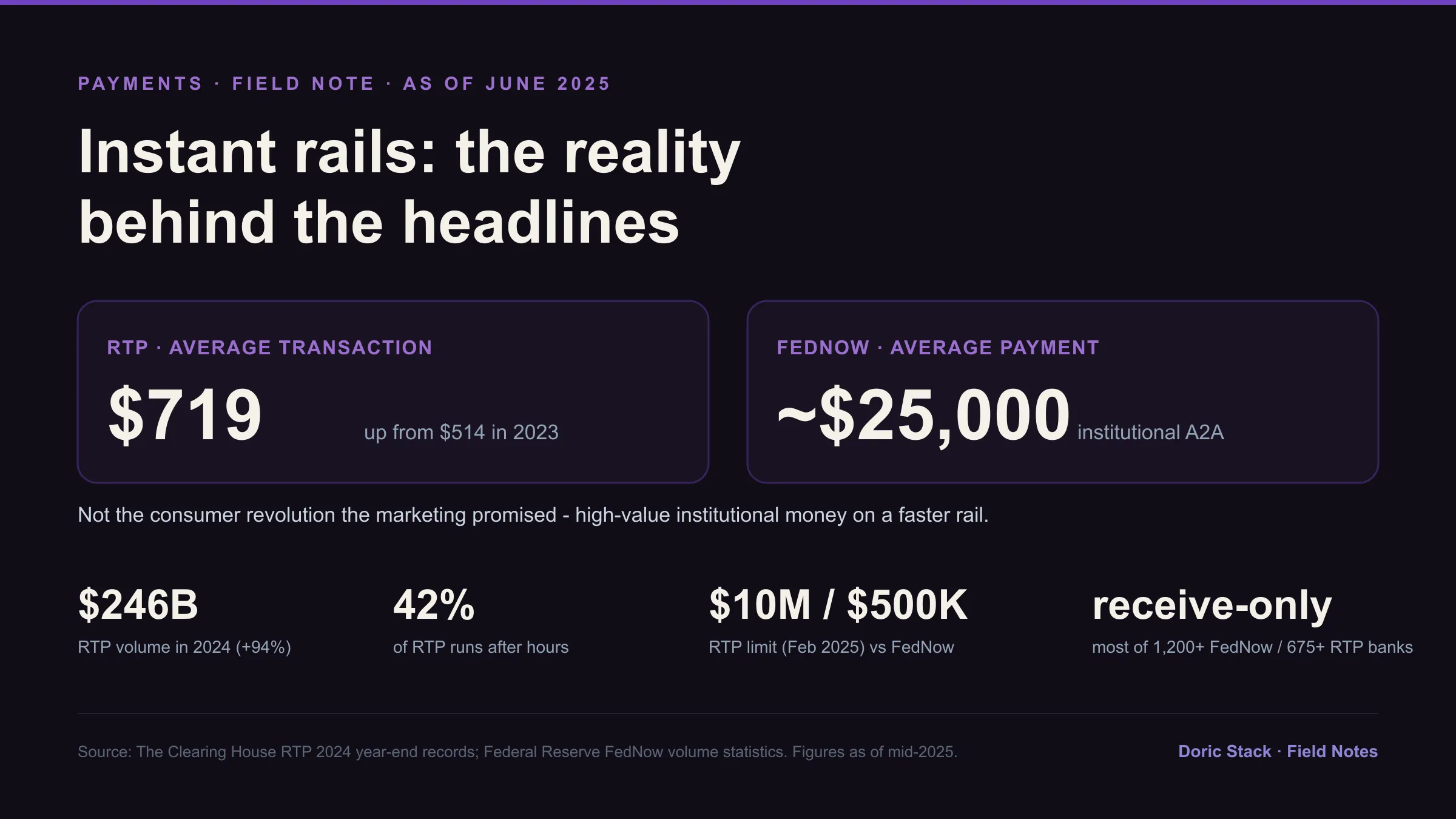
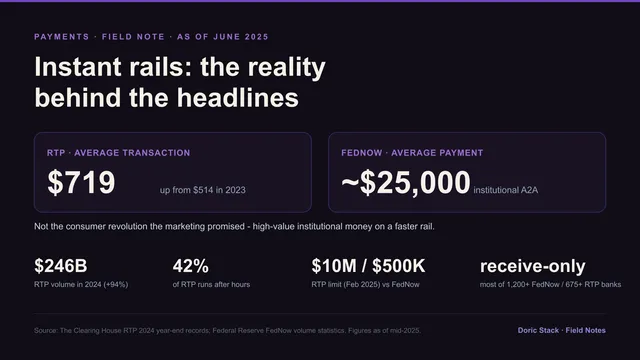
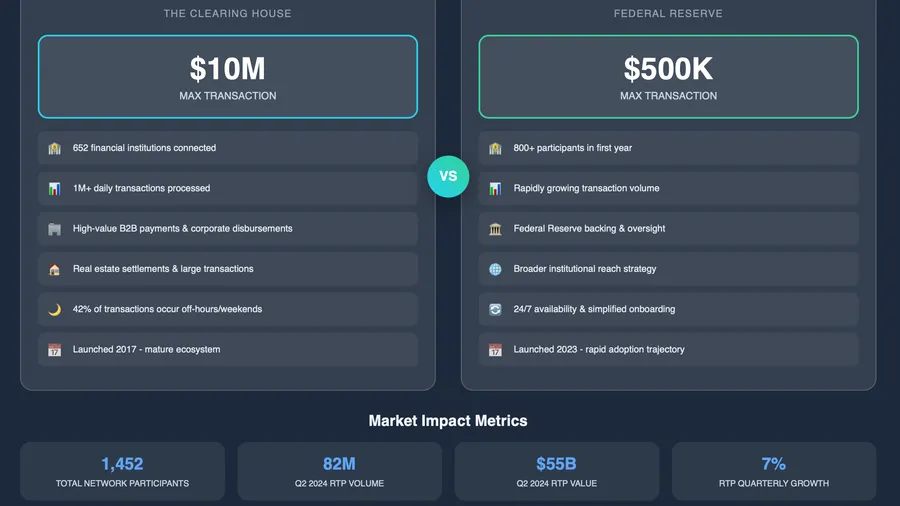
As of June 2025: RTP's average transaction was $719 in 2024 (up from $514 in 2023); FedNow's average payment was about $25,000, driven by corporate and brokerage account-to-account use. RTP did $246B in 2024 (+94%), 42% of it after hours; RTP's limit rose to $10M in Feb 2025 while FedNow stayed at $500K; most of the 1,200+ FedNow and 675+ RTP institutions are receive-only. Sources: The Clearing House, Federal Reserve.
Same rails the headlines celebrate, read through actual usage instead of launch volume.

Marketing vs usage (June 2025)

Marketing vs usage (June 2025)

As of June 2025: RTP's average transaction was $719 in 2024 (up from $514 in 2023); FedNow's average payment was about $25,000, driven by corporate and brokerage account-to-account use. RTP did $246B in 2024 (+94%), 42% of it after hours; RTP's limit rose to $10M in Feb 2025 while FedNow stayed at $500K; most of the 1,200+ FedNow and 675+ RTP institutions are receive-only. Sources: The Clearing House, Federal Reserve.

RTP average

$719

per transaction in 2024, up from $514 in 2023 - everyday-sized money (The Clearing House).

FedNow average

~$25,000

per payment in 2024 - corporate and brokerage account-to-account, not consumer (Federal Reserve).

Off-hours

42%

of RTP transactions land overnight, on weekends, or on holidays - the genuine 24/7 benefit.

The tell is in the averages. A $719 RTP payment is a bill, a payroll top-up, a gig payout. A ~$25,000 FedNow payment is a treasury sweep or a brokerage funding move. That is not consumers abandoning cards and ACH - it is high-value, low-volume institutional money finally getting a real-time option. Useful, but not the everyday-payments revolution the marketing implied.

What the marketing says

Instant payments are taking off. Record volume, near-100% growth, thousands of institutions signed up. The rails are here and adoption is exploding.

What usage shows

Most of the 1,200+ FedNow and 675+ RTP institutions are receive-only - they will accept an instant payment but will not send one. Banks are cherry-picking safe use cases and avoiding the operational complexity of full integration.

The infrastructure exists and the marketing sounds compelling. Actual usage says we are still years from instant being the default for everyday money.

This is selective implementation, not broad adoption. Banks are hedging - taking the receive side, leaning on 24/7 availability where it clearly pays (42% of RTP volume is already off-hours), and waiting on the rest. The recent split in transaction limits, RTP up to $10 million since February 2025 while FedNow’s default stayed at $500,000, only sharpens the sorting: the rails are increasingly chosen by transaction size, not by a wholesale move to real time.
Was this useful?

Choose once.

Related Posts

View All Posts »
RTP vs FedNow: the $10 million strategic divide

RTP vs FedNow: the $10 million strategic divide

An $8M deal chopped into 16 payments because one bank used FedNow. With TCH-RTP at a $10M limit and FedNow at $500K, transaction size is quietly deciding which rail a corporate treasurer can use.

The Fed payment account grants the rail, not the safety net

The Fed payment account grants the rail, not the safety net

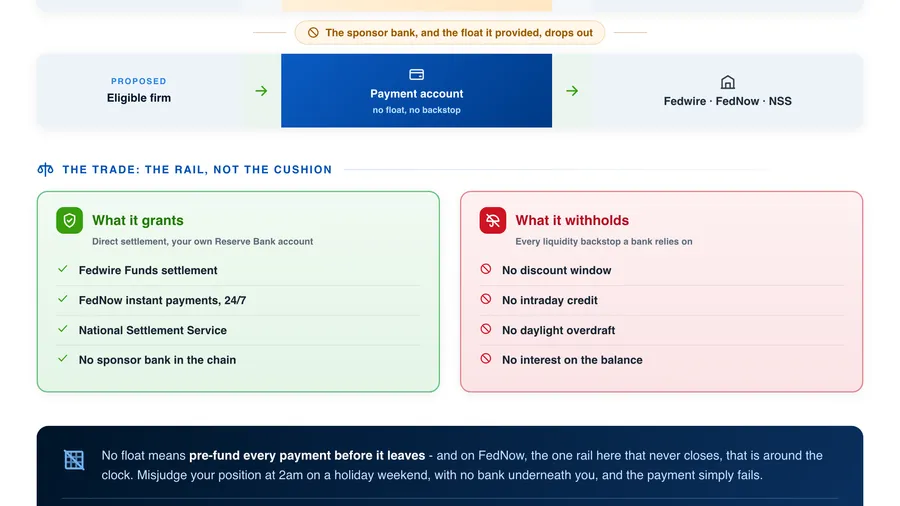
The Federal Reserve proposed a stripped-down payment account for legally eligible institutions. It can clear and settle on Fedwire, FedNow, and National Settlement Service, but it withholds the cushion that made sponsor-bank access survivable: no discount window, no intraday credit, no daylight overdraft, no interest on balances.

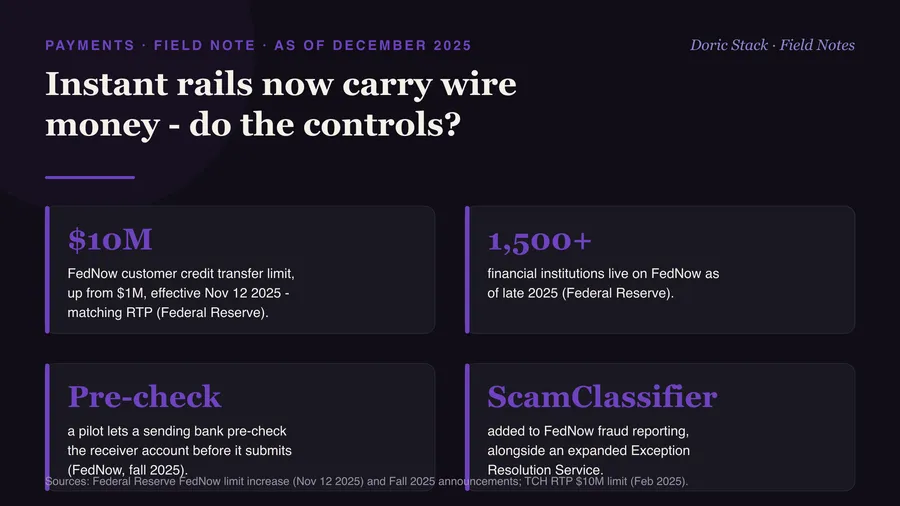
Instant rails now carry wire money. Do the controls?

Instant rails now carry wire money. Do the controls?

FedNow matched RTP at a $10M network limit in November 2025 and added new risk rails - a receiver-account pre-check pilot, ScamClassifier reporting, an Exception Resolution Service, and 1,500+ banks live. Instant is treasury cash now, and batch-era controls just got a 24/7 bypass.

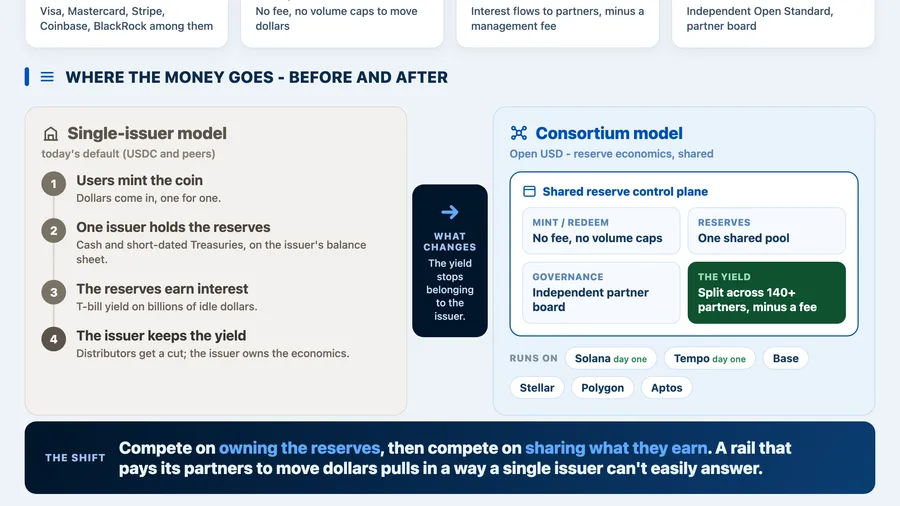
Open USD moves the stablecoin fight from issuing the coin to distributing it

Open USD moves the stablecoin fight from issuing the coin to distributing it

Open Standard announced Open USD on June 30, 2026 with a partner-backed model: no-fee mint and redeem, no volume caps, and reserve economics shared with the businesses moving the money. The technical object is another dollar stablecoin. The strategic move is shifting the revenue fight from holding the reserves to distributing the rail.